Related the post "3 useful cones" (part 1). When unrolled, these cones make up 1/4, 2/4 and 3/4 of a circle.
If you look closely, you can see all the lines/squares line up perfectly...
Showing posts with label cone. Show all posts
2012-11-23
2009-09-29
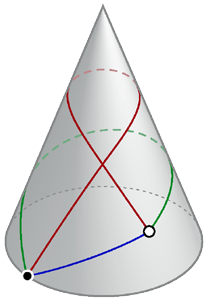
Geodesics on a Cone
Mark L. Irons did some thinking about Geodesics on a Cone.
Geodesics on a Cone is probaly the same thing as a Conic plank line.
He explains very clearly why there can be more than one geodesic line that connects two given points on a cone (or a sphere).
(Images: Mark L. Irons)
2009-04-16
3 useful cones
These 3 cones unroll to 270, 180 and 90 degrees, which can be useful if you want to line up an orthogonal pattern. For example rectangular plywood sheets.
2009-03-30
Explaining the five cases of elastic bending
At the moment, this is how I would explain the geometry of the 5 cases of elastic bending (see previous post):
Case #1 This one follows the elastica curve, which means the curvature varies with the sin of distance along the curve (explanation here). The curve equals half a cycle of Sin (180 degrees) which means the curvature will be zero at start point and endpoint.
[EDIT 2010-06-13] This case probably involves the Cornu spiral (clothoid), see here and here.
Case #2 This is probably* a part of a clothoid curve (Cornu spiral). Curvature is maximum at the clamped end and zero at the loose end. There is a linear change in curvature in between. (A loose end cannot store any bending energy and the curvature there must be zero).
*(This could possibly be simply half an elastica curve, but I find that less likely).
Case #3 This is a circle (cylinder). Curvature is constant along the curve.
Case #4 This is a helix. Curvature is constant along the curve and there is also a constant twist. This could also be called a cylindrical plank line, which means it has the shape of a thin (straight) strip that has been wrapped around a cylinder.
Case #5 This is a conic plank line, which means it has the shape of a thin (straight) strip that has been wrapped around a cone.
Case #2 This is probably* a part of a clothoid curve (Cornu spiral). Curvature is maximum at the clamped end and zero at the loose end. There is a linear change in curvature in between. (A loose end cannot store any bending energy and the curvature there must be zero).
*(This could possibly be simply half an elastica curve, but I find that less likely).
Case #3 This is a circle (cylinder). Curvature is constant along the curve.
Case #4 This is a helix. Curvature is constant along the curve and there is also a constant twist. This could also be called a cylindrical plank line, which means it has the shape of a thin (straight) strip that has been wrapped around a cylinder.
Case #5 This is a conic plank line, which means it has the shape of a thin (straight) strip that has been wrapped around a cone.
Etiketter:
3d,
cone,
cornu spiral,
curves,
elastica curves,
helix,
my investigations,
plank line,
twisting
Five cases of elastic bending
I have so far identified five cases of elastic bending in a thin strip:
Case #1
Two loose ends pushed together (2d).
Case #2
Case #3
Both ends clamped together to form a loop (2d).
Case #4Both ends clamped to form a loop, but with a distance sideways between endpoints (3d).
Case #5Both ends clamped and twisted to form a loop (3d).
Case #1
Two loose ends pushed together (2d).
One clamped end, the loose end is pushed (2d).
Both ends clamped together to form a loop (2d).
Case #4Both ends clamped to form a loop, but with a distance sideways between endpoints (3d).
Case #5Both ends clamped and twisted to form a loop (3d).
Etiketter:
3d,
cone,
curves,
elastica curves,
helix,
my investigations,
plank line,
plywood,
twisting
"Conic plank line"
I would like to introduce the term "Conic plank line". (See these images).
The meaning being what I have earlier described as "Cone strip" or "Wrapping a cone with a straight strip".
2009-03-09
Loop comparison. Investigation completed?
I hesitated for some time before I compared the new Grasshopper-generated Cone Strip with the original digitized saw blade surface. It took some fine tuning of the "Cone Angle" parameter and some scaling+rotating to find the corresponding shape.
After having compared the two surfaces closely I have found that they are almost identical!
Please download the 3d-model (rhino .3dm-file) and have a look for yourself.
After having compared the two surfaces closely I have found that they are almost identical!
Please download the 3d-model (rhino .3dm-file) and have a look for yourself.
Well, this pretty much concludes my investigation I think! You are welcome to prove me wrong!
Thanks for your interest in this blog!
Mårten
Etiketter:
3d,
3dm,
cone,
digitizer,
grasshopper,
my investigations,
plank line
2009-03-08
Single curved Cone Strip
Etiketter:
3d,
cone,
ghx,
grasshopper,
my investigations,
plank line,
rhino
More cone testing
Generating the cone plank line directly in Grasshopper (no ToyCar). The strips turn out slightly double curved. Why? Probably because the surface is a loft between lines that are perpendicular to the plank line curve (they shouldn't be, they should all point towards the tip of the cone and vary in length).
Etiketter:
3d,
cone,
grasshopper,
my investigations,
plank line,
rhino
2009-03-06
ToyCar plug-in for Rhino by David Rutten
David Rutten at Robert McNeel was kind enough to revive his plug-in named "ToyCar" for me. The ToyCar runs along a surface and finds a plank line path on it. PLEASE NOTE that the plug-in is not yet finished!
ToyCar + Grasshopper helped me create this:
Thanks for your help David!
ToyCar + Grasshopper helped me create this:
Thanks for your help David!
Etiketter:
cone,
found elsewhere,
grasshopper,
plank line,
rhino,
toycar
2009-03-05
2009-03-02
Collar on the cone
Today I discovered that the loop I have been trying so hard to understand may in fact be a part of a cone!
The loop sits like a collar on the cone.
The loop photographed from the cone focal point.
This is a bit of a breakthrough! It's interesting that such a simple paper model can be so useful. In CAD, how would you constrain a straight strip to follow the shape of a (developable) cone?
The loop sits like a collar on the cone.
The loop photographed from the cone focal point.
This is a bit of a breakthrough! It's interesting that such a simple paper model can be so useful. In CAD, how would you constrain a straight strip to follow the shape of a (developable) cone?
Subscribe to:
Posts (Atom)